

Management and DiSC® styles
The DiSC® model can be used to highlight the strengths of individual managers as well as their stressors. DiSC can uncover hidden assumptions each style might bring to their work, their impact on their teams, and actionable strategies they can use to increase their effectiveness.


“In fact, management is a set of well-known processes, like planning, budgeting, structuring jobs, staffing jobs, measuring performance and problem-solving, which help an organization to predictably do what it knows how to do well. Management helps you to produce products and services as you have promised, of consistent quality, on budget, day after day, week after week. In organizations of any size and complexity, this is an enormously difficult task. We constantly underestimate how complex this task really is, especially if we are not in senior management jobs.”
Who are managers? What do managers do?
Pick your favorite management guru and ask for a definition of management. The response will probably include something like Henri Fayols’ definition of the five functions of management: planning, organizing, staffing, directing, and controlling. Or maybe the response will be more along the lines of Peter Drucker’s list: setting objectives, organizing the group, motivating and communicating, measuring performance, and developing people. Others might add reporting and budgeting functions.
No matter how your organization defines management, it’s a critical role. Managers are held responsible for making sure their teams execute the vision and meet the goals of the organization’s executives. They are expected to resolve problems and find solutions, whether they are regarding personnel or other resources.
Are managers and supervisors the same?
The roles of managers and supervisors do differ, although some skills are beneficial for both: good communication skills, for example, and organization skills. Managers tend to focus more on what work is getting done and what resources or policies are necessary to facilitate that work. Supervisors are more focused on making sure the manager’s decisions are being implemented. They are more focused on task completion and instruction.
Both managers and supervisors need the soft skills necessary to resolve personnel conflicts, motivate employees, and offer any direction necessary for completing tasks. Managers need to set policies, develop engagement initiatives, and create a healthy workplace environment. Managers shape the culture of their teams.
What are DiSC management styles?
The DiSC model can be used to highlight the strengths of individual managers as well as their stressors. DiSC can uncover hidden assumptions each style might bring to their work, their impact on their teams, and actionable strategies they can use to increase their effectiveness.
The following descriptions have been taken from the Everything DiSC® Management profile and How to Stop The Great Resignation (PDF).
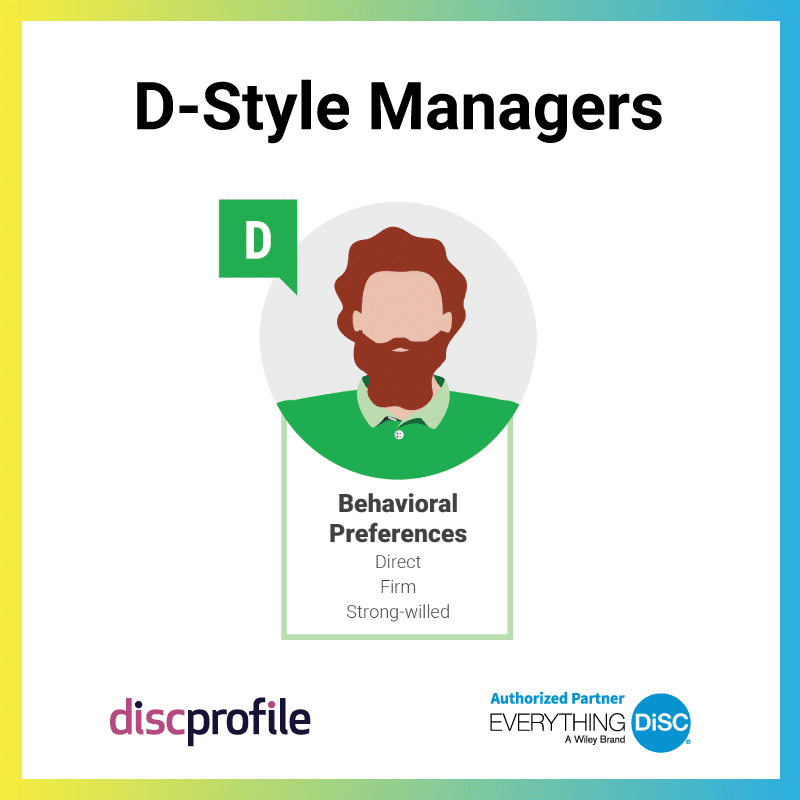
D-style managers
Managerial strengths of the D style:
- willingness to take risks
- comfort with being in charge
- confidence in their opinions
- persistent through failure
- competitive spirit
- ability to find effective shortcuts
- ability to create a sense of urgency in others
A key to developing these managers is helping them truly appreciate the value of empathy in leadership. By understanding other perspectives, they see that not everyone shares their sense of urgency. They can often get better results in the end by showing compassion in the moment.
Unconscious assumptions that D-style managers sometimes make:
- I’m the manager—people need to adapt to me.
- Praise should be used very sparingly.
- I don’t need to be tactful if I’m being honest.
- I can’t show weakness or vulnerability.
- People are getting paid—they don’t need morale building.
- I’m the best suited to make most decisions.
- It’s fine to use a little intimidation to get things done.
- People who need emotional support are expecting coddling.
- I should be the one in control.
- If we get results, that’s what matters.
- Everyone should be as driven as I am.
- I’m the manager—it’s OK if I lose my temper.
- I can’t slow down.
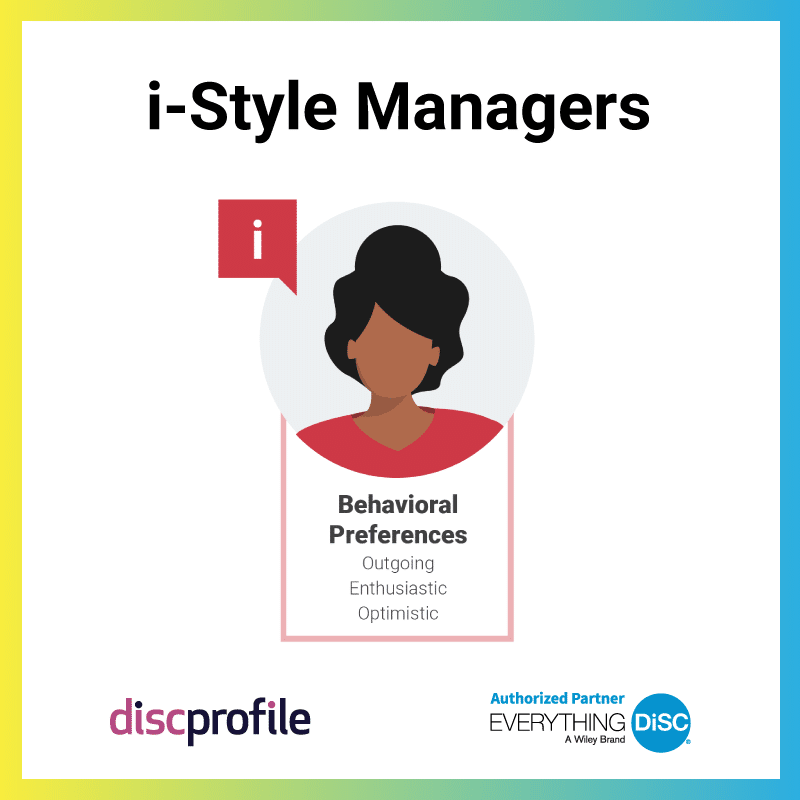
i-style managers
Managerial strengths of the i style:
- willingness to experiment
- willingness to accept new ideas
- collaborative, interested in working with others
- comfort in taking the lead
- persistence through optimism
- ability to rally others around an idea
- tendency to give praise and encouragement
One of the core insights that will help these managers is realizing just how much more stability, predictability, or control others might need compared to them. By understanding other perspectives, they see that not everyone shares their comfort with improvisation or emotional expression. Sometimes they’ll need to take a more task-oriented or tough-minded approach.
Unconscious assumptions that i-style managers sometimes make:
- Most people are fine with improvising.
- People who are quiet and reserved need to be brought out of their shells.
- I have to express my feelings when I have them.
- If someone shows confidence, they’re probably competent.
- I need to keep things upbeat.
- The team should keep things positive, all the time.
- I shouldn’t jeopardize my popularity.
- It’s OK to build up excitement for an idea, even if it’s only a vague possibility.
- Showing my enthusiasm will get everyone excited.
- Everyone should assume the best, like I do.
- It’s better to move on than dig into problems.
- Everyone craves excitement.
- If I give critical feedback, our relationship will never recover.
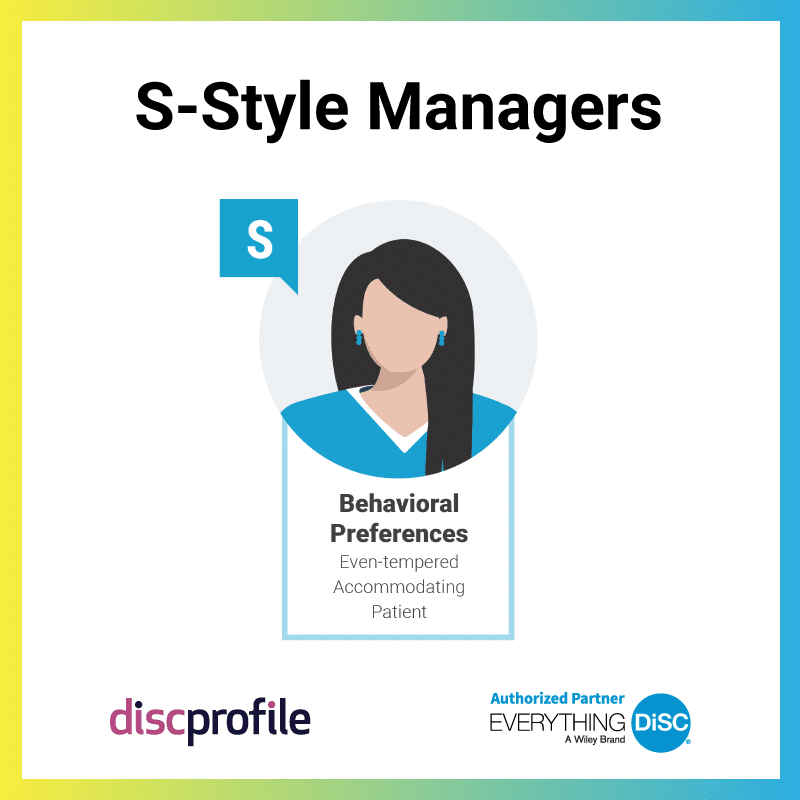
S-style managers
Managerial strengths of the S style:
- interest in maintaining steady progress
- diplomatic approach
- support of team members and team goals
- provides information clearly and systematically
- tendency to follow through on commitments
- understanding of others’ perspectives
- ability to work with different types of people
These managers grow as they start to appreciate that sometimes they’ll actually have to invite tension and instability into their world. By understanding other perspectives, they see that not everyone shares their need for harmony. The long-term well-being of their team often depends on allowing a little short-term messiness.
Unconscious assumptions that S-style managers sometimes make:
- It’s my job to keep my team happy at all times.
- I shouldn’t upset people.
- It’s rude to be too assertive.
- If there is uncertainty, inaction is the best course.
- If people are sorry, other consequences aren’t necessary.
- Direct, critical feedback should only be a last resort.
- It’s better to give people what they want.
- Slow and steady is better than unpredictability.
- I shouldn’t inconvenience other people.
- My needs are less important than other people’s.
- I shouldn’t push people to push themselves.
- You should always give people the benefit of the doubt.
- I need buy-in from everyone before I finalize a decision.
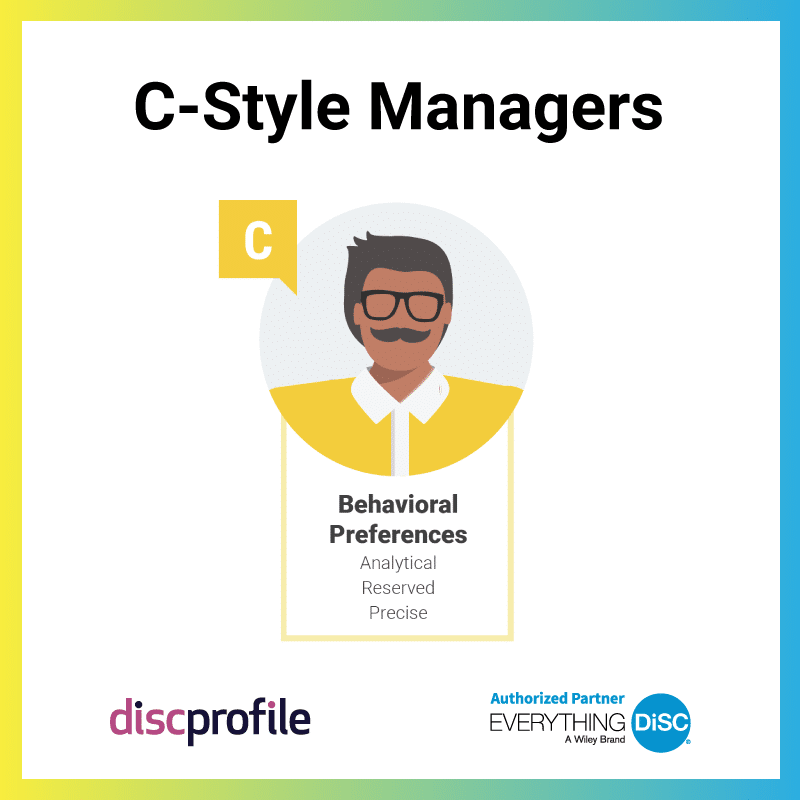
C-style managers
Managerial strengths of the C style:
- high expectations and insistence on quality
- ability to look at ideas and problems logically
- faces challenges head-on
- ability to exercise caution and manage risks
- interest in developing systematizing tasks
- persistence in finding and analyzing solutions
- lays out expectations objectively
These managers often need help appreciating that to grow as a leader, they’ll need to embrace the humanity of their direct reports on a deeper level. By understanding other perspectives, they see that the people they manage often need praise, excitement, optimism, camaraderie, or risk-taking at a much greater level than they do.
Unconscious assumptions that C-style managers sometimes make:
- If I make a mistake, I’ll lose my credibility.
- If people haven’t gotten negative feedback, they will assume they’re doing a good job.
- We need all the information before we make a big decision.
- It’s undignified to show intense or tender emotions at work.
- Time spent relationship building is largely frivolous.
- My judgment is completely objective and unbiased because I use logic.
- Emotions have no place in decision-making.
- There’s one best way of doing things.
- If my feedback is objective and fair, I don’t need to cater to people’s feelings.
- I need to consider all the variables before I decide.
- You should keep emotions to yourself.
- If I make a bad decision for the group, it will never be forgotten.
- I’ve thought this through and there’s no better way to see it.
Everything DiSC Management cornerstone principles
Everything DiSC Management is an assessment and personalized learning experience proven to increase the effectiveness of anyone in a management role. Using the DiSC model, your Management profile will give you a deeper understanding of yourself, your direct reports, and your own managers.
The Everything DiSC Management model is based on these principles:
- All the DiSC styles are equally valuable, and people with all styles can be effective managers.
- Your management style is also influenced by other factors such as life experiences, education, and maturity.
- Understanding yourself better is the first step to becoming more effective with your employees and your manager.
- Learning about other people’s DiSC styles can help you understand their priorities and how they may differ from your own.
- You can improve the quality of your management experience by using DiSC to build more effective relationships.
Which DiSC profile is best for management?
Of course, as we see from the cornerstone principles above, people with any DiSC style can be effective managers. Their personality style matters much less than the training they receive.
Recent surveys such as this one by McKinsey & Company (2021) show what employees want most:
- feeling valued by their manager
- having a shared sense of connection with the company’s mission
- believing they are valued by the organization
- having work-life balance
One’s DiSC style does not prevent a manager from meeting these types of expectations of their staff. Similarly, DiSC styles do not indicate if a manager will be able to learn the skills needed for more digital and automated workplaces.
An assessment like Everything DiSC Management prepares anyone in a management role to successfully engage, motivate, and develop their people. A person’s style influences the tips they receive in the profile, but isn’t predictive of their success as a manager.
The difference between what employees want vs. what employers think they want is a problem. Managers must adapt their approach to keep their people during The Great Resignation by focusing on the human aspects of work.
Managers often make the mistake of seeing one-on-ones as little more than clutter on their calendars. Here are tips to make one-on-one meetings a time for conversation, for building a relationship, and for ongoing feedback in both directions.
Do you want to increase the probability that the discussion will be fruitful? The Everything DiSC model can help.